

Introduction
Even though lead has been banned from gasoline and pet we still see the problem on occasion, so after reading this page check around your house if you have pets and children.
Lead is a heavy metal and can easily cause a toxicity (called plumbism) in birds. Other heavy metals, notably zinc, can also cause toxicity. Some birds can have both.
Lead toxicity can also affect people, especially children. You can learn more about this problem in children from the American Academy of Pediatrics (AAP). You can also learn more about this from the Environmental Protection Agency (EPA).
Cause of Lead Toxicity in Birds
Birds are sometimes drawn to shiny objects, hence they will eat metallic objects that can contain lead. Birds are natural chewers and will chew cage bars and painted walls.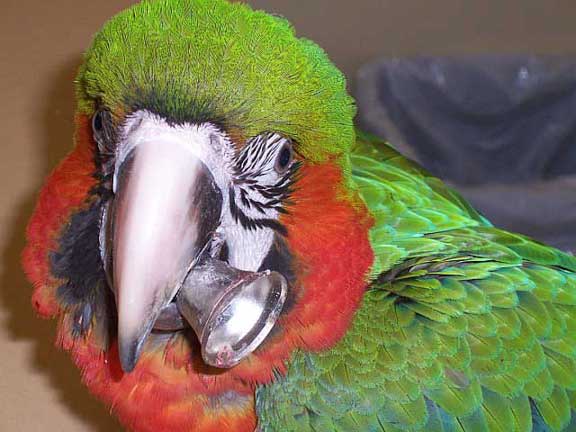
Don’t underestimate what a bird what get into, like this macaw with a bell stuck on its tongue
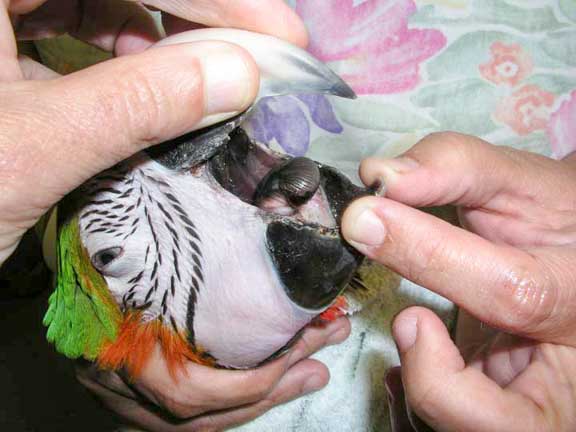
After lots of special lubrication and gentle manipulation with special instruments, he was good to go again. Click here if you want to see how we removed the bell stuck on the tongue of this bird.
In older homes there are sometimes layers of paint below the surface layer that contain lead. Lead particles can build up on the ventriculus (gizzard) and become toxic if in large enough quantity.
Lead is a heavy metal that is poorly absorbed by the intestines. Unfortunately, only a small amount is needed to cause problems. It eventually gets distributed to all body tissues, with particular emphasis on the digestive system, the red blood cells, the bone marrow, the liver and the nervous system.
Sources of lead could include; old paint, old cages, solder, stained glass, curtain weights, foil, fishing weights, batteries, linoleum, plaster, and putty. Birds can even chew on jewelry that contains lead or zinc.
Signs of Lead Poisoning in Birds
Symptoms depend on how much lead is ingested over how long a period of time. The disease is sometimes broken down into acute lead toxicity and chronic lead toxicity.
In the acute version birds might be weak, depressed, produce abnormal droppings, and vomit. Neurologic signs could include walking in circles, twitching, incoordination and even convulsions. If it is anemic from the lead it might be breathing hard.
This bird is showing severe neurologic signs that could be from lead toxicity.
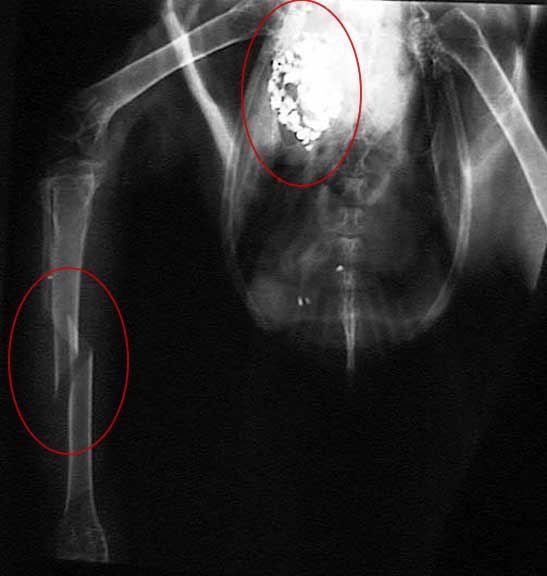
Chronically infected birds can have similar symptoms to acute toxicity. In addition, they might lose weight, be partially or fully paralyzed, and even blind. A weak bird can fall and even break a bone (you will see a radiograph of that in this page).
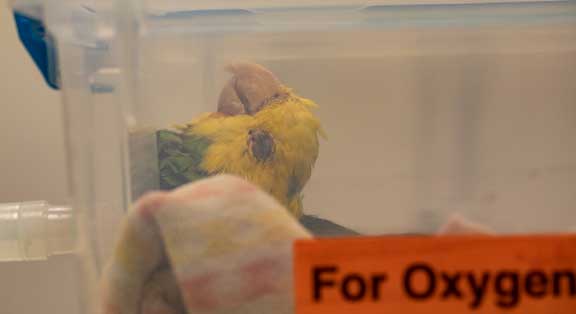
This ill bird in oxygen has a neurologic sign called a head tilt. This can occur in lead toxicity.
There are other different symptoms of lead toxicity that might be present. If a bird is anemic enough it might have breathing problems. This is an emergency in a bird or any other exotic or domestic species, and needs to be examined by one of our veterinarians as soon as you see any sign of an increased respiratory rate.
The Long Beach Animal Hospital, staffed with emergency avian vets, is available until the evenings 7 days per week to help if your bird is having any problem, especially breathing hard or bleeding. Think of us as your Long Beach Animal Emergency Center to help when you need us for everything from minor problems to major a major emergency.
We serve all of Los Angeles and Orange county with our Animal Emergency Center Long Beach, and are easily accessible to most everyone in southern California via Pacific Coast Hwy or the 405 freeway.
If you have an emergency that can be taken care of by us at the Animal Emergency Hospital Long Beach always call us first (562-434-9966) before coming in so that our veterinarians can advise you on what to do at home and so that our staff and doctor can prepare for your arrival. To learn more please read our Emergency Services page.
This video shows a bird that has severe breathing problems (called dyspnea) being treated with 100% oxygen. The sound you hear in the background is the oxygen generator.
Diagnosis
History
In some lead infected birds there is a history of recent chewing of paint on the walls. In some cases the owners did not suspect any exposure to lead.
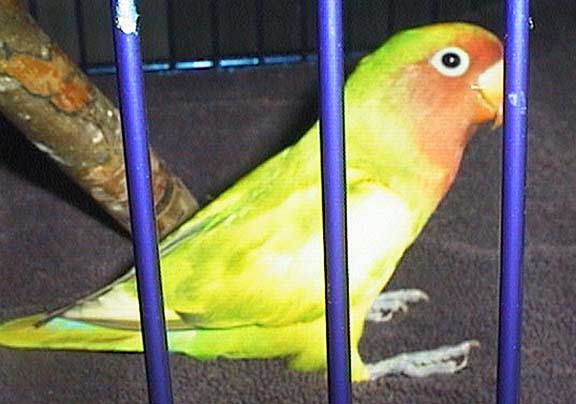
This bird with lead toxicity cannot walk on his legs
Physical Exam
The physical exam may or may not reveal significant abnormalities. It all depends on how much lead has been ingested over how long a period of time.
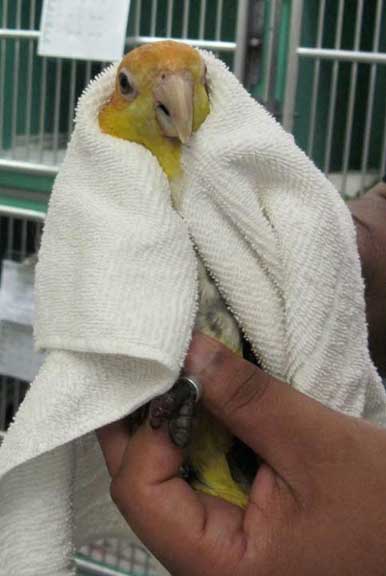
Birds that have lead toxicity can be very ill, so they are handled gently with a towel at all times during an exam and when obtaining diagnostic tests
Diagnostic Tests
Blood Panels
A blood panel might be useful in this disease. In some birds we might see anemia. Anemia is checked on an avian blood panel by checking the hematocrit (HCT). This is a percent of the red blood cells in the serum. The blood panel also checks the liver enzymes and WBC count.
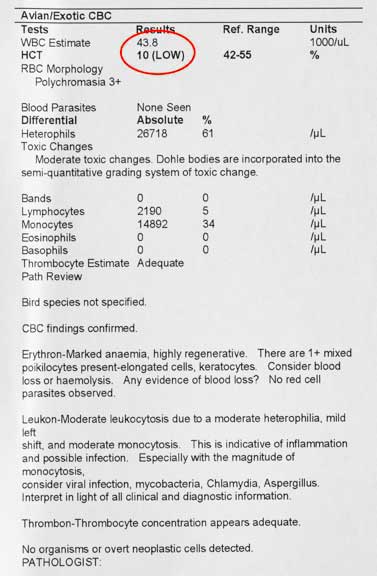
This bird blood panel shows an HCT of 10% when it should be at least 42%. This is severe anemia.
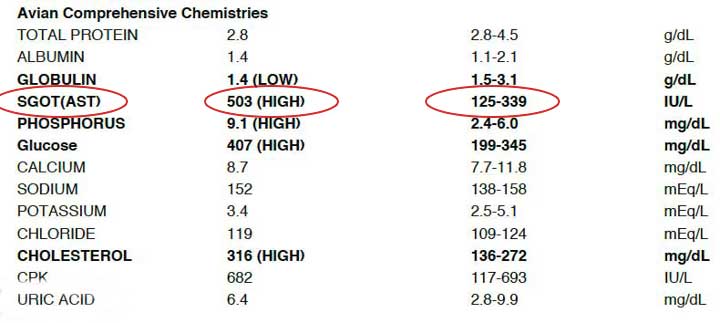
The SGOT (serum glutamic oxaloacetic transaminase), test on our avian blood panel checks the liver. This one is 503, a normal value is up to 339.
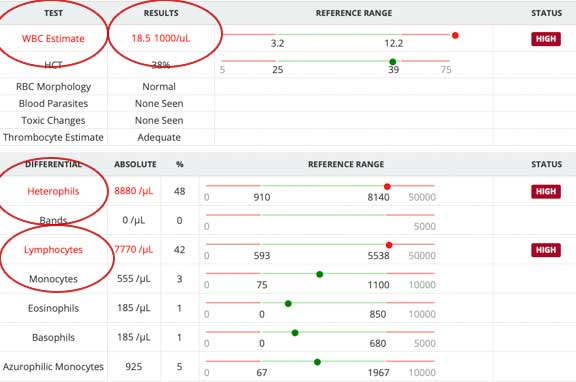
This bird does not have anemia. It does have an elevated WBC count of 18,500, which can occur in birds with lead toxicity, inflammation, or infection.
When we suspect lead toxicity we can run a lead level on the blood. A blood lead level gives us a more accurate indication if lead toxicity is present
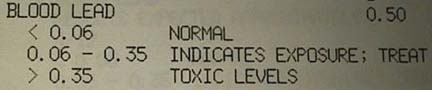
This is from the bird above. His lead level is 0.5 parts per million (ppm), far above the normal range of less than 0.06
Our Diagnostic Tests page has much more information on the wide array of tests we perform on animals.
Radiographs
One of the most consistent ways to diagnose lead toxicity is with an x-ray. Lead is a heavy metal and will show up vividly on a radiograph, usually in the ventriculus (gizzard).
You can learn more about reading radiographs and why lead is one of the five radiographic densities by clicking here. You will learn lots, and when you come back here you will understand all five of the radiograph densities in the following radiographs much better.
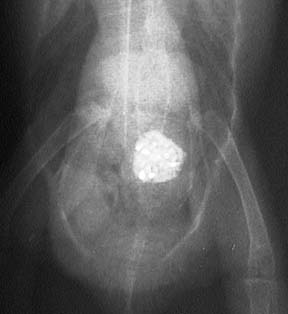
This bird is laying on its back. You can easily see the bright lead particles in its gizzard (stomach)
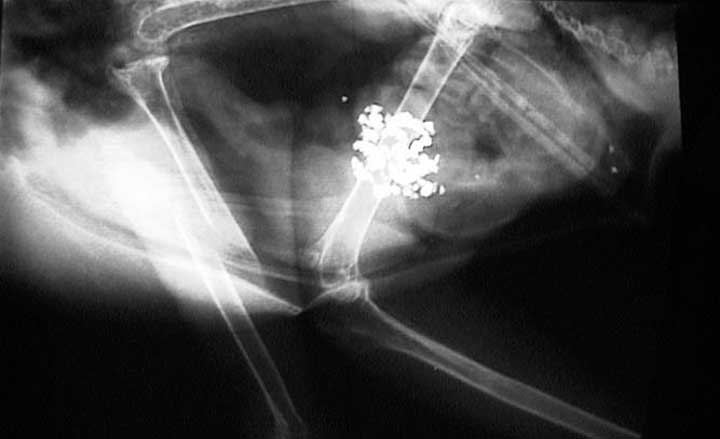
The metallic density of the lead particle seen in the very center of this radiograph are hard to miss. Do you see the fractured tobiotarsus also?
Is Lead Poisoning Treatable in Birds?
Lead Poisoning Treatment
Birds that are weak, losing weight, or not eating need supportive care. This consists of fluids and supplemental feeding. We will frequently hospitalize them until they regain their strength. If they are having seizures we can put them on anticonvulsant medication.
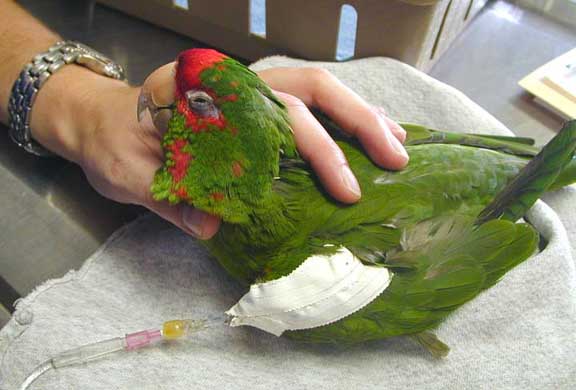
Most of these birds are ill enough to be hospitalized and given IV fluids
It is important to try to remove the lead from the ventriculus. Treatment with lubricating agents or even peanut butter will help pull the lead out of the gizzard to be passed in the droppings. On rare occasions, especially if the lead particles in the ventriculus are too large to pass, we will perform surgery to remove them.
Once your bird is stable and we have attempted to remove the lead from its ventriculus we use a class of medications called chelating agents. Their job is to go into the organs, especially the bone, where the lead has accumulated and counteract its affects. It can take several courses of treatment to completely treat your bird.
These medications are not without risk, so they are used intermittently to give your bird a rest period in between doses. We will treat until the lead level in the blood test is back to normal and there is no more radiographic evidence of lead in the ventriculus.
Prevention
It is the nature of birds to be chewers and put metallic objects in their mouth. Minimizing their exposure to lead containing objects is an obvious way to prevent this problem. Also, feeding them a balanced diet (not just seed) will help keep them from looking for nutrients they need and are not receiving in their diets.