

Goal
To provide appropriate guidance and leadership to our dogs so that they learn the rules and customs of living in human society.
Tools you will need
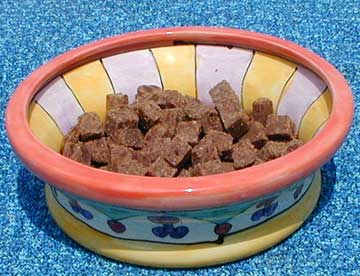
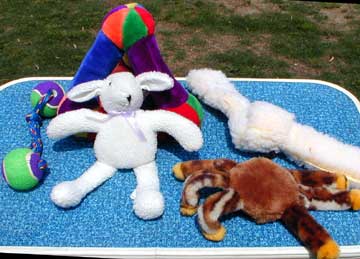
Just you and your dog and some yummy treats and fun toys
Overview
There are many dog training books that still promote the myth that dogs do things because they want to “dominate” us. This “domination theory” has probably led to more abuse of dogs than any other reason. It has led people to believe that they must use physical force and aversive training techniques to train their dogs.
This belief comes from two sources. First, studies of wolves were used to learn more about dog behavior. Although the dominance theory explains a lot about pack hierarchy in a family of wolves, it does little to help us when it comes to understanding dogs’ place in the human family. Second, much of traditional dog training stems from the 1950’s and is based on a militaristic training style that is founded upon teaching the dog “who the boss is” and compelling the dog to comply “or else.”
Contemporary dog training is now based on learning theory that has been around since the 1940’s. Pick up any college psychology text, gain an understanding of classical conditioning (also known as Pavlovian conditioning) and operant conditioning, and you have the foundation of how dogs learn.
Simply put, dogs do what works. If jumping on you in greeting gets reinforced, then your dog will jump on you. If you let your dog in the house when she/he whines or barks at the back door, your dog will whine and bark at the back door. If your dog beats you through a doorway, she/he will keep beating you through doorways. The dog is not trying to dominate you when she/he is doing these things.
The dog does these things because they work and she/he has not been taught alternative behaviors. The cardinal rule to remember in training dogs of any age is: Reinforce the behavior you want and remove reinforcement (voice, touch, eye contact) for behavior you don’t want. Reinforce, reinforce, reinforce!
Through our leadership and guidance, we can teach our dogs to defer to us when going through doorways, not to jump on visitors, and all the myriad of other behaviors that will make your dog a welcome member of the family, and the larger community in which she/he lives.
Step-by-Step Tips
The following are a few examples of how you can start teaching your puppy to defer to you and to look to you for guidance in his/her worldly affairs.
Jumping
When your puppy jumps up on you, consider this a natural greeting of friendliness. Your 8-week old puppy is not trying to dominate you. She/he is saying hello and seeking affection and interaction. From the moment you bring your puppy home, start teaching him/her that jumping doesn’t work.
Teach your pup that sitting or standing with “four on the floor” works. To do this simply sidestep the puppy’s jump so the jump ends up in the air, or pivot away from the puppy
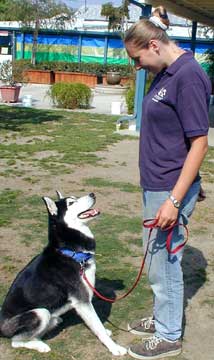
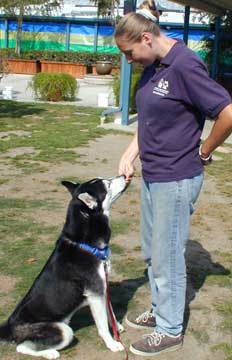
Repeat this until the puppy doesn’t jump. Then, say “Yes!” and give the puppy a treat or pet him/her. always reinforce (praise, treats, petting) the absence of jumping and remove all reinforcement (eye contact, voice, and touch) for jumping. To help your pup out even more, teach him a substitute behavior such as sit. (See the section on “Basic Manners.”) Then, when the puppy tries to jump, you can sidestep and ask for a sit instead. Remember, reinforce the behavior you want or you will get something else you may not want!
Body slamming through doorways
Many puppies like to run through doorways ahead of us. In many cases this is not a problem. However, some times, especially as the puppy gets bigger, this can pose a safety issue for children and others who can be knocked down by a boisterous dog. additionally, teaching a pup to defer to your presence in a doorway will help set the stage for deference to you in other areas of his life.
Instead of letting your puppy bump into you getting through doorways, try body-blocking. Body-blocking is simply asserting your personal space. You can put a leg in front of the pup, blocking his path.
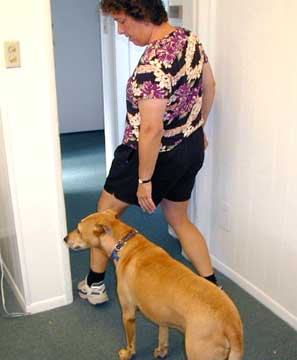
When he pauses or stops, say “Yes!” and give him a treat, or praise and pet. You can also put your puppy on a leash or a housel ine and hold the puppy back as you pass through first, rewarding your pup for deferring. Practice this throughout the house, and soon your puppy will learn to respect your personal space needs.
Feeding Times
Teach your pup to sit quietly while you prepare his/her meal. If your puppy barks or whines while you are preparing the meal, simply stop your preparations, and when the puppy pauses (she/he has to take a breath sometime!), say “Yes!” and resume preparations. Stop and repeat each time the puppy fusses.
Next, wait for the puppy to sit before you place his/her bowl on the floor. When your pup sits, start lowering the bowl.
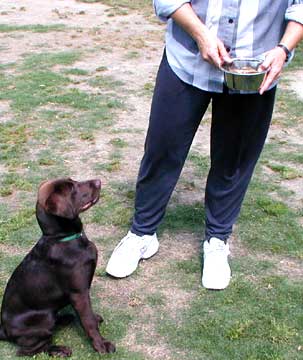
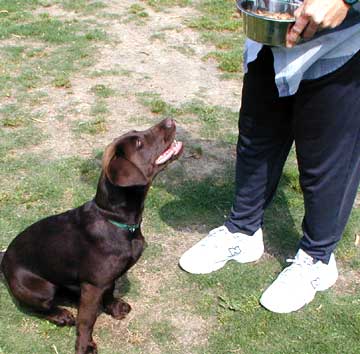
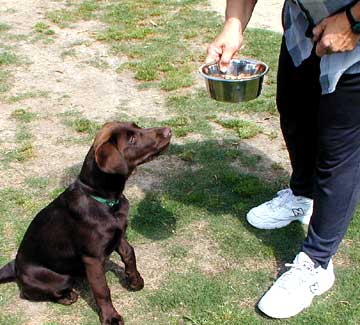
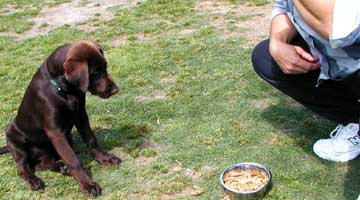
If your puppy jumps up, straighten back up and wait for him/her to sit again. Keep it up until you get a sustained sit while you lower the bowl. at the beginning, accept a brief sit, but gradually build up to a sit that lasts until you say “Okay!” before letting him/her go to the bowl.
Attention on Demand
Do not reinforce your puppy for demanding your attention. If your puppy solicits petting, play, or other interaction, teach him/her to do something first. “Sit” and “Down” are great places to start for all puppies. (See the section on “Basic Manners.”) Ignoring your puppy’s insistent demands for attention and rewarding him/her for those little jobs (Sit and Down) will go a long way in establishing yourself as the leader of your pack.
Basic Manners
Teaching puppies behaviors such as Sit, Down, Stay, Leave It, and Off, as well as tricks such as Spin, Wave, and Shake Paws, are great tools in establishing the puppy’s place in the household. Puppies are little sponges; they soak up everything around them. They are always learning, whether we teach them or not. So why not teach them the things we want? See the section on Basic Manners for more information.
Recommended Reading
The Perfect Puppy: How to Raise a Well-Behaved Dog by Gwen Bailey
Leader of the Pack. . .and have your dog love you for it! By Patricia B. McConnell, PhD
Puppy Primer by Brenda K. Scidmore and Patrical B. McConnell, PhD