

The purpose of the cardiovascular system (heart and blood vessels) is to provide the cells of the body with oxygen, nutrition, and essential fluids. It also helps these same cells rid themselves of waste products, and distributes hormones and enzymes to allow for normal physiologic processes. It is even a big part of temperature regulation.
All of this is no small feat when you consider the fact that the cardiovascular system must supply these needs to a body that contains billions of individual cells. Add to that the fact that this occurs in animals as small as tiny insects and mammals as large as whales. It is a wonder of nature to say the least.
The cardiovascular system is very complicated and does not lend itself to a simple explanation and categorization of its functions. Therefore, the sections on physiology and pathophysiology are a little complex, but if you get through them it will help in your understanding when we talk about specific diseases along with their diagnosis and treatment.
You may need to go through them more than once. You might notice that we repeat important concepts, and from different angles. Hopefully this will help put it all together later when learning about diagnosis and treatment of heart disease in animals.
You can bypass all the background information and go directly to specific diseases like Heartworm, Cardiomyopathy, and Valve disease, the most common heart diseases we encounter.
We also have a summary page on Heart Disease if you find this page contains more detail than you need. It will give you background information but in a condensed format.
This page has actual pictures of the heart and the organs of the chest. Most people will not be bothered by their graphic nature, and will actually find them fascinating. The mechanisms of heart failure in the dog and cat are very similar to humanoids. The explanation of congestive heart failure applies directly to people in many cases. The main drugs used to treat heart failure are almost identical in people and animals.
Heart disease and its diagnosis is complicated stuff. We commonly call in our cardiologist Dr. Fred Brewer, to assist in many cases. He specializes only in cardiology, and has extensive knowledge that he is willing to share.
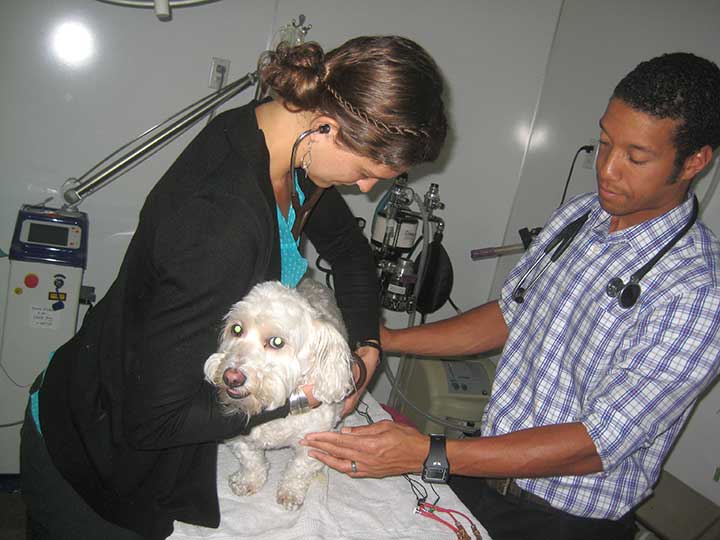
Here is Dr. Brewer explaining heart sounds to one of our externs
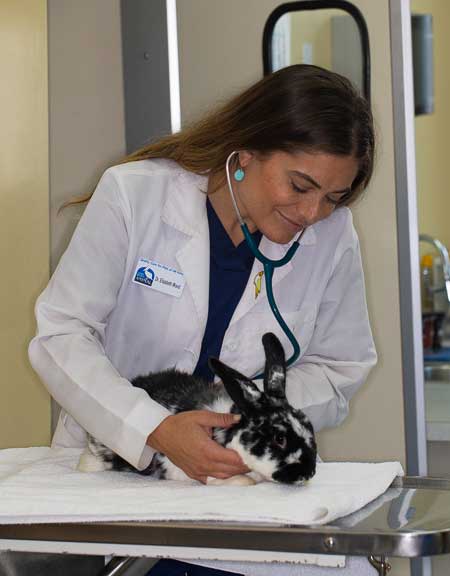
We work on a wide variety of species that get heart disease in addition to dogs and cats

This guinea pig has heart failure
This is the heart of a 50 pound dog. It is about the size of your fist. You can easily see some of the coronary arteries that supply blood to the heart muscle in the same manner that the heart supplies blood to the rest of the body.
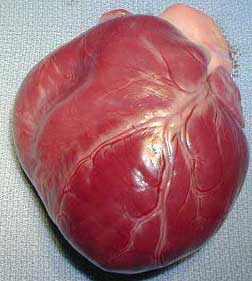
The pericardium, the outer layer of tissue surrounding the heart, has been removed for better visualization

This smaller heart is from a ferret. Now you can see the pericardium, the layer over the heart as it is pulled away.
The heart starts beating before birth, and continues until death. Think of how many beats that is in the lifetime of any living organism. Let’s have fun with math and play with some basic numbers:
- Average heart rate in a cat- 150 beats per minute
- This is 9,000 beats in one hour
- This is 216,000 beats in one day
- This is 78,840,000 beats in one year
- This is 788,400,000 beats in 10 years.
Many cats have a heart rate greater than 150 beats per minute, and live much longer than 10 years. They will have over a billion heart beats in their lifetimes!
Later in this page we will be referring to the right heart and left heart, which might give you the impression there are two hearts. There is only one heart- we do this only because it helps to understand the flow of blood through the heart.
A dog or cat in heart failure can have a difficult time breathing due to fluid buildup in the lungs. This is a medical emergency requiring immediate veterinary care because it can lead to death. The Long Beach Animal Hospital, staffed with emergency vets, is available until the evenings 7 days per week to help if your pet is having any problems, especially shock, pain, difficulty breathing, or bleeding.
Think of us as your Long Beach Animal Emergency Center to help when you need us for everything from minor problems to major a major emergency. We serve all of Los Angeles and Orange county with our Animal Emergency Center Long Beach, and are easily accessible to most everyone in southern California via Pacific Coast Hwy or the 405 freeway.
If you have an emergency that can be taken care of by us at the Animal Emergency Hospital Long Beach always call us first (562-434-9966) before coming. This way our veterinarians can advise you on what to do at home and so that our staff and doctor can prepare for your arrival. To learn more please read our Emergency Services page.
Glossary of heart terminology
| cardiac– pertaining to the heart | aerobic– dependent on oxygen for normal physiology |
| arrhythmia– irregular heart beat | anaerobic– not dependent on oxygen for normal physiology |
| murmur-abnormal flow of blood through the heart valves | anemia– low number of red blood cells |
| atrium-two of the smaller heart chambers | systole– when the heart muscle contracts and ejects blood to the arteries |
| ventricles– two of the larger heart chambers | diastole– when the heart relaxes after systole and fills up with blood |
| hypertrophy-abnormally thickened heart muscle | ascites- fluid buildup within the abdomen |
| cardiomegaly- an enlarged heart | pleural effusion– fluid buildup within the thoracic cavity |
| pulmonary edema– fluid buildup within the lungs | polycythemia- excess number of red blood cells |
| myocardium– the heart muscle | microcardia– a small heart |
We will repeat this terminology throughout this page to help you eventually get your Latin down pat. Just as it starts making sense we will add more later!