

Introduction
Disease associated with the canine parvovirus started appearing around 1978. It is postulated that this virus is a mutation of the feline distemper virus. Since so few dogs had developed natural antibodies in the late 1970’s, a large number of dogs died from this disease. In some cases, the virus affected the heart, and caused death within a few hours.
We can still remember people coming into our clinic in droves to get their dogs vaccinated. There was no parvo vaccine for dogs then, since we did not even know what parvo was. The vaccine we gave initially was the cat feline distemper vaccine since there was no dog parvo vaccine available at the time. Our universities and drug companies immediately responded to the challenge, and identified the virus and manufactured a highly effective vaccine.
Decades later most dogs have encountered the parvovirus, either naturally (maternally) or through vaccines. These natural antibodies pass on to puppies (called maternal antibodies) when they nurse in the first few days of life. Maternal antibodies initially give a pup protection from parvovirus, along with many other viruses and bacteria. They last for a variable period of time, and start diminishing by around 2 months of age, yet can stay around until 5 months.
It is at this time that a pup starts becoming vulnerable to the parvovirus, so we begin vaccines then. We never know exactly when these maternal antibodies diminish, which is why we give the parvo vaccine in a series. If we start the series much before 2 months of age we are wasting it because the maternal antibodies will negate the effects of the vaccine. In essence, we are trying to give the vaccine just as the maternal antibodies are diminished, and just before the pup becomes susceptible to an exposure to the parvovirus. This is why sometimes a dog vaccinated for parvo gets an infection.
There are reports of people and cats getting this disease, but in our locale this is almost non-existent. The big cats in places like Africa get this virus. Pigs can get their own version of parvovirus, but it does not affect dogs or act in a similar manner.
This disease is still prevalent, as evidenced by the number of e-mails we receive regarding this topic. Many of these dogs would not suffer this problem if they were properly vaccinated. Preventing this disease is dramatically more effective (not to mention less expensive) than treating it.
A puppy with parvo can rapidly become dehydrated and hypothermic (low body temperature) and go into shock. This is a medical emergency requiring immediate veterinary care. The Long Beach Animal Hospital, staffed with emergency vets, is available until the evenings 7 days per week to help if your pet is having any problems, especially shock, pain, breathing hard, or bleeding.
Think of us as your Long Beach Animal Emergency Center to help when you need us for everything from minor problems to major a major emergency. We serve all of Los Angeles and Orange county with our Animal Emergency Center Long Beach, and are easily accessible to most everyone in southern California via Pacific Coast Hwy or the 405 freeway.
If you have an emergency that can be taken care of by us at the Animal Emergency Hospital Long Beach always call us first (562-434-9966) before coming. This way our veterinarians can advise you on what to do at home and so that our staff and doctor can prepare for your arrival. To learn more please read our Emergency Services page.
What is Parvo Virus in Dogs
This is a serious disease that causes a dog to stop eating, vomit intensely, and have a very bad and oftentimes blood diarrhea. Some dogs do not recover from this, even when treated. This stresses the importance of immediate medical care when a young dog is ill.
What Causes Parvo in Dogs?
The disease is caused by a highly contagious virus that is transmitted mostly by dogs orally contacting infected feces. Being a virus, they contain only DNA or RNA, and are not capable of reproducing unless they invade a cell. Once inside the cell they take over and force the cell to produce so many new virus particles that the cell eventually bursts, releasing these new virus particles into the bloodstream and tissues so they can invade other cells. The only thing that can stop this is the immune system.
Viruses are the smallest of know living organisms, and can only be seen with special microscopes called scanning electron microscopes, that cost millions of dollars (ours is on order). The parvovirus is extremely small (the Latin word for small is parvo)- just 1 thimble full of stool can contain millions of virus particles. It is easy to see why contamination occurs so readily. Incubation period varies from 5-10 days. As in many viral diseases of the intestinal tract, some dogs can pick up the disease and shed the virus without significant symptoms in themselves. These carrier dogs have what is called a subacute infection.

This is an electron microscope view of a cluster of parvo virus particles. It is courtesy of Dr. Cornelia Büchen-Osmond Biosphere 2 Center. “Universal Virus database of the International Committee on Taxonomy of Viruses, ICTVdB. The scale at the bottom shows the length of 100 nanometers (nm). A nanometer is 1 billionth of a meter, so it is obvious these particles are real small
The virus has 3 basic strains:
- CVP2 which was the first one found in 1978
- CVP2a came on the scene in the early 80’s
- The strain most prevalent today is CVP2b
Eventually a new strain will appear because the virus will adapt to the immune system of dogs.
The parvovirus can linger in the environment for many months, allowing it to affect other dogs. It can withstand common household disinfectants (except bleach) and can withstand freezing winter temperatures. It can be spread on the hair and feet of dogs, in addition to shoes, clothes, and eating utensils.
We tend to see parvo in dogs that have other diseases, especially intestinal parasites (worms). This might be because these dogs have immune systems that are weakened, making them more susceptible to a viral infection. Also, the parvo virus capitalizes on the fact that the lining of the intestines of these dogs with intestinal parasites are damaged and susceptible to the parvovirus.
Pathophysiology of Parvo
Parvovirus has a predilection for rapidly dividing cells (similar to cancer). The rapidly dividing cells in a dog are the intestines, bone marrow, and the immune system. When the virus infects these areas the lining of the intestine literally dies, the bone marrow cannot make red or white blood cells in adequate quantity, and the immune system can become impaired.
Initially the virus replicates in the tonsils (which are lymph nodes) after oral ingestion. The virus rapidly multiplies and enters the bloodstream within a few days. From here it spreads to those parts of the body that contain rapidly dividing cells as mentioned above.
The main cause of death in parvo infected dogs is septicemia. Poisons from bacteria that are attacking the susceptible lining of the intestines release toxins into the bloodstream. These toxins add to the complications of a puppy that is dehydrated from vomiting, diarrhea and not eating, is hypoglycemic from not eating, and has electrolyte imbalances from vomiting and not eating. The bodies immune system becomes overwhelmed and death ensues if treatment is not instituted early and aggressive enough. Even if toxins are not released by bacteria, the dehydration and electrolyte imbalance that occurs can lead to shock and eventual death.
In actuality, whether a pup recovers from the virus depends on a race between parvovirus particles causing septicemia and dehydration, and the immune system’s ability to neutralize the virus. Fortunately, for most pups that get medical care early enough, the good guys win the race.
Symptoms of Canine Parvo
The majority of dogs presented with parvovirus show signs of fever, lethargy, vomiting, diarrhea, and lack of appetite. In severe cases the diarrhea is very watery and frequently bloody, with a telltale odor. They are very ill, with significant abdominal pain. The virus is so strong that it literally causes the lining of the intestines to slough. It is painful to eat, and with the severe diarrhea and vomiting that is present, they rapidly become dehydrated. The also have a disruption in their electrolytes (sodium, potassium, chlorine) that adds to the weakness.
There is a complication that can occur from all the intestinal activity regarding vomiting and diarrhea. It is called an intussusception, which is literally a telescoping of the intestine into itself. This will cause the intestine to die, resulting in death of the pup. Treatment is surgical, unfortunately, these pups are in no shape for surgery. Luckily we do not encounter this very often, if at all.
Graphic pictures of intussusception to follow.
In the peracute form of this disease the virus attacks the heart and causes rapid death. Fortunately, it is rare to encounter this nowadays.
Diagnosis of Canine Parvo
The diagnosis of canine parvovirus is frequently made by age of pet (usually under 6 months of age), symptoms exhibited, and physical exam. Other diseases can mimic the signs of parvovirus, so x-rays and routine blood samples are sometimes run to help eliminate them as a cause. A CBC (complete blood count) might show a reduced white blood cell level, an indication that a virus is present in the body. A blood sample can be run looking for Parvo antibodies, but the results are open to interpretation as to whether the dog has an active infection or not.

An accurate, simple to perform, and inexpensive test has been developed to test the feces for the virus. It can be performed by our in hospital lab within 15 minutes.

If only one vertical bar appears the test is negative

When two vertical bars appear the test is positive
Recent vaccinations can interfere with the interpretation of this test. No test is perfect though, and like many diagnostic tests for diseases, there can be false positives and false negatives.
How is Parvo Treated in Dogs?
Dogs with parvovirus need immediate veterinary care because they are usually very sick. They should not be treated at home if they are significantly ill. This care involves large amounts of intravenous fluids, added electrolytes, antibiotics, and special medications to minimize vomiting. It is common for them to be hospitalized for anywhere from 3-7 days.
A new treatment called CPMA (Canine Parvovirus Monoclonal Antibody) has been shown to aid in recovery. This monoclonal antibody binds to the virus and neutralizes the virus at the viremic stage. As it becomes available we will be using it in treatment.
We monitor red blood cell counts and protein levels to identify those dogs that are not responding to routine treatment. If the protein level becomes low we institute therapy with additional fluids (called colloids) to combat the problem. Dogs that continue to decline in spite of therapy may also need a blood transfusion because they can become anemic and deplete their protein. We will also treat the internal parasites (worms) that can be an integral part of this disease.
Special precautions are taken when we treat parvo dogs. They are put in a special area so that we can monitor them closely. They are also isolated so that other dogs in the hospital are not exposed to the virus.

Staff members that treat them wear disposable gloves and gowns, and clean their shoes in a special chlorine foot bath to prevent hospital contamination of the virus.

We do all of our work in our isolation room, including placing an intravenous (IV) catheter and treatments
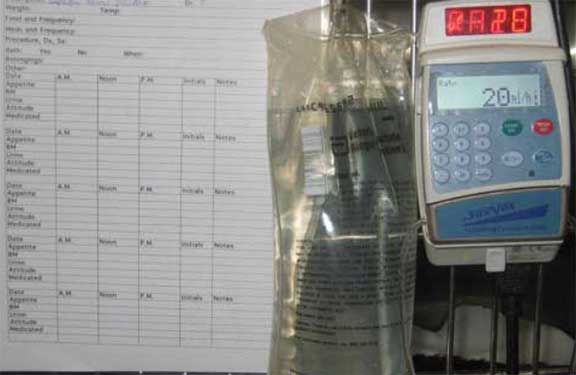
Intravenous fluids, given with a special fluid machine that gives out the exact quantity of fluid needed as determined by a doctor, is crucial in the treatment
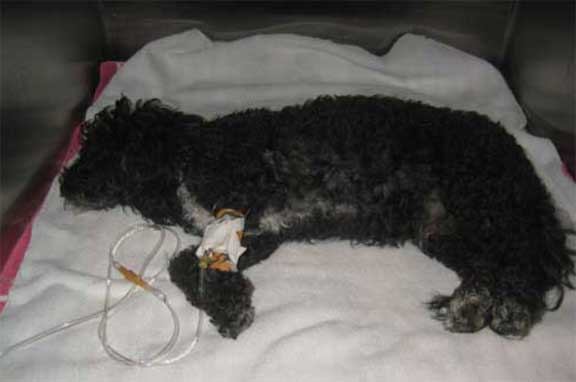 Parvo patients are very ill and need special treatment and nursing care if they are to pull through it
We do not feed them until they have had some supportive care like fluids and antibiotics. We need to get them eating soon so the lining of the intestines can function properly, and so they don’t go into a negative nitrogen balance.
We will send your dog home if it is eating and not vomiting for 24 hours. We expect it to have a persistent soft stool or diarrhea for several days after returning home. You might even send home supplemental fluids for several days.
Fortunately, most dogs recover with our intensive therapy, although there still is an occasional dog that does not. This may be due to a weak immune system that cannot produce adequate antibodies, or a particularly strong (virulent) strain of the virus that we encounter occasionally. Dobermans and Rottweilers seem to be especially sensitive to this virus, and have the most difficult time recovering from an infection.
Some dogs strain so much from the diarrhea that they develop an intestinal blockage called an intussusception. This is where the intestines telescope into each other, and requires surgery to correct. It is fatal if not corrected. An intussusception is diagnosed with a radiograph and confirmed with ultrasound.

The advent of digital radiography has dramatically improved our ability to diagnose problems like this

This is what the intussusception looks like internally
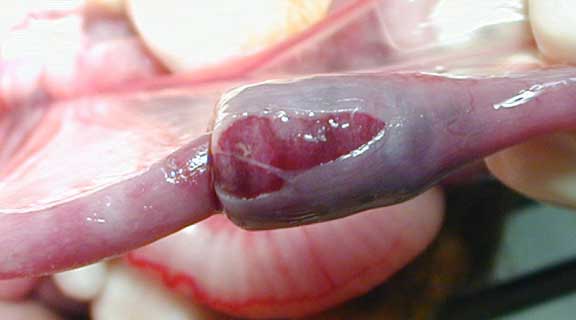
A different dog with intussusception during surgery to correct it
Once your dog is well on its way to recovery we will send it home with supplemental fluids, antibiotics to be given orally, along with a special bland food made for recovering patients with gastrointestinal disease . It is called I/D (Intestinal Diet). Even though the pup might be ravenous, feed the food in small amounts frequently.
Your dog should be rechecked within a week to make sure it is putting on weight and thriving. At that point we will continue (or in some cases begin) its routine vaccination series. Since the pup is potentially contagious to other dogs, it is well advised to keep it away from other animals for at least 30 days since it can still spread the virus.
Pups that have recovered from parvo do not get the disease later in life. They can completely recover and lead a normal life.
Tips to Prevent Canine Parvo
As with all infectious diseases, minimizing exposure from infected animals is the most effective means of prevention. Since infected dogs shed large amounts of virus in their stool, contamination is always a possibility. The virus is quite resistant in the environment, especially in public areas that are not disinfected. This is a good reason to keep your pup away from these areas until it is older, worm free, and had its full series of dog vaccines.
Since this disease occurs mostly in puppies, worms (internal parasites) and poor nutrition add susceptibility. Puppies should be wormed frequently until they are 3 months old.
Any dog you already have in the household before you exposed it to a parvo dog you recently brought in (whether it died or recovered from the parvo) should be current on its vaccines and should have minimal exposure, if possible, to the contaminated areas. It is rare for an adult dog that is current on its parvo vaccine (yearly boosters) to get parvo.
If you had a dog die of parvo we recommend thorough cleaning with diluted bleach (1:30 with water, or 4 ounces of Clorox in a gallon of water) and waiting 1-2 months before introducing a new dog to the area. Spray the yard as best as possible with a hose and keep new dogs away from the area for 1-2 months. Do not put bleach on your dog to rid it of parvo.
Vaccines are highly effective. Dogs should be vaccinated at 8, 12, and 16 weeks of age. Ideally, we should vaccinate pups every 2 weeks starting at 6 weeks of age and lasting until 5 months of age, especially in the more susceptible diseases. Puppies should not be exposed to other dogs or their feces until at least one vaccine is given. Puppies need to socialize at the critical 6-16 weeks of age mark, and if you do not expose them to other dogs early in life you might have a serious behavior problem later as an adult. So use precaution until your pup’s vaccine series is complete.