

Introduction
Urinary bladder infections (UTI- Urinary Tract Infections or cystitis) are common in cats, especially females. As we learn more about this disease we realize many factors are involved when a cat gets a cystitis. This page will talk about some of them and how we handle this vexing problem that varies in symptoms and treatment in every cat.
This problem can progress, and it can become serious, especially in male cats. It this occurs it is sometimes called FLUTD (Feline Lower Urinary Tract Disease). It is sometimes also called by its previous name, Feline Urologic Syndrome (FUS).
FLUTD is a disease of the urinary tract that is sometimes related to the buildup of crystals, leading to inflammation of the lining of the urinary bladder and urethra. In many cases there is no crystal buildup, so dietary changes will be unhelpful.
For years these cats were treated with a food that acidified the urine. This food has been the gold standard for treating cats with this problem, and has helped many cats get over this disease. This acidification can be harmful though, especially in a cat with kidney disease. It can also predispose at cat to getting calcium oxalate bladder stones.
There are two forms of FLUTD. The unobstructed form, in which your cat is having a difficult time urinating, but is still able to urinate. In the obstructed form, your cat cannot urinate. This is a medical emergency. You will learn how they are both treated in this page.
Always pay close attention to your cat’s urinary habits. If your cat is having a hard time urinating, and especially if it is a male cat, this is a medical emergency. Do not wait to see if the problem goes away.
The Long Beach Animal Hospital, staffed with emergency vets, is available until the evenings 7 days per week to help if your pet is having a problem with urination. We serve all of Los Angeles and Orange county, and are easily accessible to most everyone in southern California.
If you have an emergency always call us first (562-434-9966) before coming in so that our veterinarians can advise you on what to do at home and so that our staff and doctor can prepare for your arrival. To learn more please read our Emergency Services page.
We have a page on bladder stones that should be read in conjunction with this page.
Graphic pictures on this page.
A significant percentage of cats will have a UTI in their lifetime. Sometimes there are no external symptoms, but we know they have it because we find bacteria when we culture their urine. If a cat has diabetes mellitus, hyperthyroidism, or kidney disease, it has an 85% chance of getting a UTI in its lifetime.
Cause
Bacteria are the cause of a UTI. A urine culture and sensitivity, obtained by cystocentesis (directly from the bladder), will let us know which bacteria are involved. By far, the most common one is E. Coli. Others include Staphylococcus and Proteus. Staph species can produce urease, which will change the pH of the urine, and needs to be addressed during treatment.
The different species of bacteria are unique in how they cause this problem. Here are some of the ways they are unique:
- How well they adhere to the urinary bladder wall with pili or fimbriae
- If they secrete a toxin
- If they are already resistant to an antibiotic, with resistance being passed on from prior generations of bacteria
- If they are resistant to an antibiotic from a recent exposure
- If biofilms are present in the bladder
Predisposing factors
There are a multitude of factors, many of which we cannot control, and are a part of this problem:
- The immune system of the pet in general
- Stress in multi cat households
- The local immune system of the lining of the urinary bladder
- How concentrated the urine is while it resides in the bladder before urination
- The length of the urethra
- The strength of the urethral sphincter in preventing bacteria from going up the vulva or penis into the blader
- How complete a pet empties its bladder (voiding)
- Anatomical defects
- If bladder or kidney stones are present
- It a diabetic cat has glucose in the urine (Glucosuria)
- Obesity and cleanliness around the external genitalia
- Reproductive problems
Obviously, there are many factors, which is why this problem can be difficult to treat and recurrence is common.
FLUTD
Crystal formation is a part of this syndrome. The crystals that form in the bladder and urethra are caused by many factors, some of which are not understood. They include diet, urinary tract infections, and stressors we are not aware of. These were discussed above under predisposing factors.
Fortunately, the dietary factors and infections can be controlled, and even prevented. In a significant number of cases no cause can be determined. The name of the disease in this case is called idiopathic FLUTD. Idiopathic means that a cause cannot be identified at this time.
Two of the more common minerals that cause these crystals are struvite and calcium oxalate. Struvite is a combination of 3 minerals; magnesium, ammonium, and phosphorous. We tend to encounter this mineral combination in young adult cats. They are usually treated with diets to decrease the pH of the urine.
Calcium oxalate is the other common mineral. It tends to occur more in older cats. They are usually treated with surgical removal when found in the urinary bladder.
Diet
One of the predisposing factors in FLUTD is the magnesium (ash) content of the diet. It used to be thought that diets low in magnesium are particularly helpful in preventing the struvite crystal problem. This is not true in most cases, it is the change in urine pH from alkaline to acidic that prevents struvite crystals.
In spite of this, many cat foods have restricted magnesium. Unfortunately, this diet can predispose to calcium oxalate crystals. After many years of treating cats with this low ash food we started to see an increase in calcium oxalate crystals for this reason. This is another example of how subtle changes in physiology, that make sense at first glance and are used successfully for many years, can have untold manifestations later.
Urine pH
It has been found that the the higher the pH (the more alkaline), the greater is the tendency for struvite crystals to form. High quality cats foods help keep the pH in the acidic range, helping to prevent struvite crystals from building up. Unfortunately, this acidic (low pH) urine now predisposes cats to calcium oxalate crystals.
As a matter of fact, we are starting to see these crystals more commonly than struvite. They also tend to form with excess use of cortisone. Cortisone is used frequently to treat animal diseases, and it is literally a life-saver. An example is the disease called Addison’s (hypoadrenocorticism). Without cortisone the pets that have Addison’s are very ill.
It is important to know the pH of the urine to determine the best way to prevent buildup of crystals. For an accurate determination, the pH of your cat’s urine should be measured immediately when removed from the bladder.
Infection
Urinary tract infections might predispose cats to getting this disease, although it is difficult to prove this. Even though it is rare to culture bacteria from the urine in these cats, they do respond to antibiotics. Yet many of these cats get better without antibiotics. Viruses are implicated as a cause of this disease also.
Diagnosis of UTI and FLUTD
History
These cats typically have symptoms of some type of abnormal urination. It is easy to confuse these symptoms with a cat that is constipated, so careful observation of your cat’s daily bathroom habits is important.
In some cases there are no symptoms, and the problem is found during routine diagnostic testing. Routine urinary symptoms include:
- Straining to urinate
- Blood in urine
- Urinating frequently and in small amounts
- Crying when urinating
- Urinating outside the litter box
Some can be moaning or painful upon your urination or touching the abdomen. Some are depressed, not eating, and even vomiting.
Physical Exam
When they are completely blocked from urinating the heart rate could be slow and they might be hypothermic. In advanced stages they might be laying on their side.

Every cat that is ill gets a thorough exam, no matter what the symptoms are. Dr. P’s stethoscope is placed on the left side of the chest in this cat. He is listening to the pulmonic, aortic, and mitral valves for murmurs at this location. He is also calculating the heart rate and monitoring for an irregular beat.
Blood Panel
It is routinely performed to determine kidney function and if there are any other abnormalities. The FeLV andFIV status of all cats should be known, so these tests might be included also.
Urinalysis
This is the primary way this disease is diagnosed. Urine samples can be hard to obtain because these cats urinate as soon as urine fills the bladder due to the inflammation caused by the crystals.
The following are two urine samples that could indicate a cat with FLUTD or UTI.
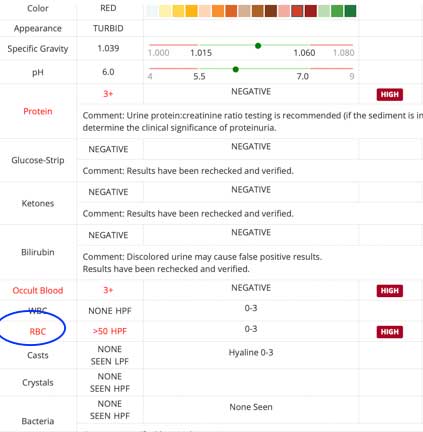
This cat only has red blood cells (RBC) without crystals
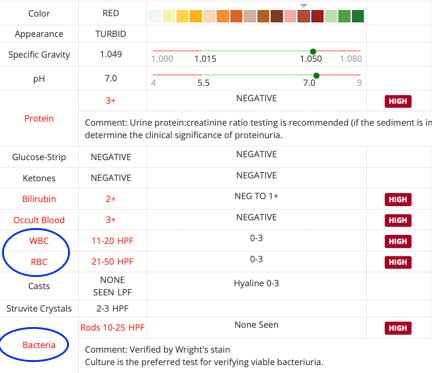
This cat has WBC’s (White Blood Cells), RBC’s, struvite crystals, and bacteria
Urine Culture
If bacterial are present in the urine, like the second urine sample above, it is important to culture the urine and do a sensitivity test.
Radiology
Radiology is beneficial to look for stones in the bladder and any other abnormalities in the abdomen.

The arrow in this radiograph points to a white area in the urethra. This is a calcified urethral plug, and makes passing a catheter difficult. This bladder is distended also, a sign that it is not urinating well due to pain or inability to urinate.
Treatment- Non-obstructed Form
Some cats will get better without any therapy at all, usually within 7 days.
Medications include cortisone to decrease inflammation and tranquilizers and antispasmodics to minimize muscle spams of the bladder and urethra. None of these medications have been definitely proven to limit the course of the disease. In addition, they all have the potential to cause side effects. Their use might be indicated as long as they do not cause more harm than good.
Oftentimes we give fluids on an out-patient basis to help flush out the urinary tract and maintain a proper state of hydration. This is a great way to help these cats, especially since they are still urinating, although with difficulty. The fluids help flush out crystals, and we are treating them in a natural way without the use of drugs.
Antibiotics are sometimes prescribed to treat this problem. The best way to decide which one to use is with a culture and sensitivity. Antibiotic resistance is becoming more and more common, so this culture and sensitivity report is important to pick the correct one.
Some bacteria are resistant to several different antibiotics. If left untreated the infection can spread from the urinary bladder to the kidneys and cause serious problems.

S- the bacteria is sensitive to the antibiotic
R- the bacteria is resistant to the antibiotic
In this report, the bacteria called Escherichia Coli., is only sensitive to two antibiotics.
The use of antibiotics in general is not recommended because bacteria are rarely cultured in the urine in younger cats. Indiscriminate use of antibiotics in these young cats can cause the appearance of resistant bacteria.
Older cats have more of a tendency to get a urinary tract infection due to bacteria . This infection might be related to several disease syndromes of older pets, especially sugar diabetes, feline hyperthyroidism, and kidney disease.
Treatment- Obstructed Form
When the quantity of crystals progresses to the point that a plug is formed in the urethra the cat becomes obstructed. This amorphous plug is not the same thing as a bladder stone. In many cats the plug that forms is made up of struvite crystals.
Cats without crystals in their urine can also get the obstructed form of the disease. This form of the disease is seen almost exclusively in male cats due to the substantially smaller diameter of their urethra. There will be repeated trips to the litter pan with straining, and crying in pain upon attempting to urinate.
Again, these symptoms can be confused with constipation. Sometimes a few drops of bloody urine are produced, although many cats cannot urinate at all. Close observation will help distinguish between constipation and difficulty urinating.
As the problem progresses these cats can start vomiting, become depressed and dehydrated, and stop eating. As the problem progresses over several more hours the kidneys are unable to function and dangerously high levels of phosphorous and potassium build up in the blood stream. If not corrected, the affected cat will die from a buildup of toxins or cardiac arrest due to the high potassium.
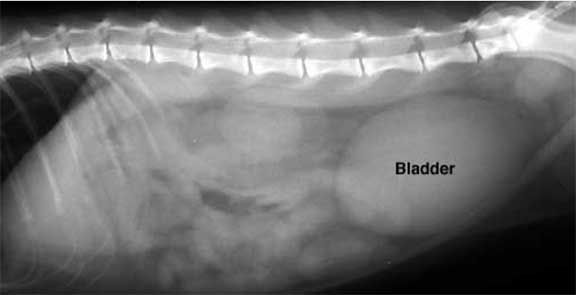
This cat’s bladder is distended because it cannot urinate. It is friable, if pushed on too hard it can rupture.

When a cat cannot urinate the potassium builds up to dangerous levels. This is called hyperkalemia, and will cause the heart to slow down substantially (bradycardia). This arrhythmia is life threatening.
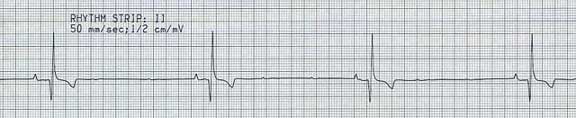
Bradycardia can also be detected on an electrocardiogram (EKG or ECG). Our Heart Page goes over this in more detail.

Cats that cannot urinate also build up dangerous levels of waste products that will detrimentally alter the pH of the bloodstream and cause organ dysfunction
Since all these symptoms are variable and can be quite subtle, the important point to remember is to observe your cats urinary habits on a daily basis and have your pet checked if there is any change to these habits. The symptoms of FLUTD can mimic other diseases, so an accurate diagnosis is imperative.
We run a blood sample on these patients to determine the degree of kidney damage. Luckily, if we treat them in time, the high kidney values return to normal, and the kidneys recover. You saw that in the blood panel above where the BUN, Creatinine, and Phosphorus were elevated. In some cats that are blocked these numbers can be 2x-3x that amount.
Obstructed cats need emergency intravenous (IV) fluids and a urinary catheter placed in the urethra. The fluids are to help flush the waste products out of the bloodstream, and remove the excess potassium and phosphorus. They also rehydrate a pet that is almost always seriously dehydrated.

Cats with this problem will be on IV fluids for several days to hopefully return the kidneys to normal function. They are put on a special IV pump monitored by our staff.
The following graphic pictures show the unblocking of an obstructed cat.
These pets also need anesthesia for us to be able to pass the urinary catheter into the urethra and start the flow of urine again. Without this sedative it can be hard to pass a urinary catheter.
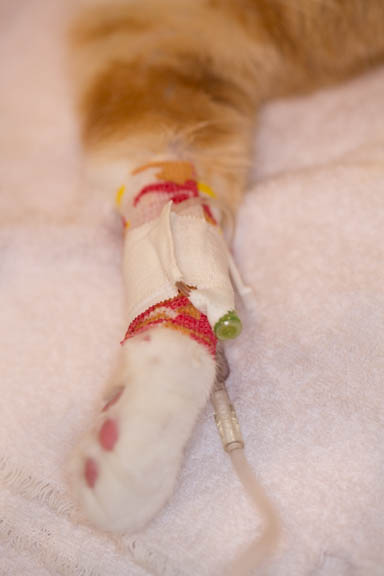
An intravenous catheter is placed in the cephalic vein located in the front leg. It is thoroughly wrapped and will be a crucial part of the treatment. It allows us to give precise amounts of injectable anesthetic in a cat with compromised kidneys.
When the fluids are running and the patient is properly sedated we flush out the mucous plug. It is sometimes at the tip of the penis, sometimes it is somewhere along the urethra.

This large mucous plug is at the tip
In most cases, a sterile small gauge IV catheter or lacrimal canula is used to gently flush out the crystals that are lodged in the urethra. This part of the procedure can take the most time because the flushing has to be gentle, yet the crystals can be almost solid in nature and difficult to flush out.

A special gentle and flexible catheter is place in the urethra once we flush out the mucous plug

When the plug is completely flushed out of the urethra the urine (usually bloody) will immediately flow from the distended bladder

To make sure the bladder is empty will pull any remaining urine out with a syringe

After we remove the bloody urine we might flush the bladder to remove crystals and mucous that can cause future urethral plugs.
The urinary catheter will be hooked up to a collection bag to monitor urine output. Keeping the catheter in the urethra will let the distended bladder rest so the injured muscles can return to normal function faster.

This collection system lets us quantify how much urine is being produced
When all the plumbing is flowing as it should be our patient is taken off anesthesia and brought a cage in our special cat ward to be closely monitored.

After making sure his body temperature is OK, Emily is transporting our patient to his private room and turning on his favorite Netflix movie

To say our patient is much more comfortable now that his kidneys are able to function again, and his bladder has been decompressed, is an understatement.
Most cats respond rapidly to treatment, and can have their urinary catheters removed 24-48 hours later. They will remain in the hospital and be closely monitored for urinary output. On occasion they can re-block and need to have their urinary catheter replaced.
Cats that have had their bladders distended significantly before they were unblocked can have a difficult time urinating after they are unblocked. Urination is painful and the muscles that contract the bladder do not function well initially. These cats will be put on medication to minimize straining, and our nursing staff will gently express the urine from their bladders when it starts to build up.
If they don’t eat well we will assist feed them. Most of these cats do well and go home in a few days. Sometimes we need owners to express the bladders at home also.
As a general rule cats with struvite crystals should be fed Prescription Diet S/D for 30 days to help dissolve crystals that remain in the urinary bladder. Our veterinarians will let you know what to feed in your cat’s specific case.
Surgical Treatment
Some cats re-block continually in spite of prevention measures. Also, some cats are so severely blocked the first time that it is impossible to flush the crystals out of the urethra and place a urinary catheter to allow the flow of urine again.
These cats need a surgery called a perineal urethrostomy, which in essence is a partial amputation of the penis. The penis is amputated far enough back to the point that the urethral opening is larger and there is minimal chance that a plug can accumulate and cause a blockage.
Prevention
Access to fresh water and the use of canned food for its added moisture content over dry food.
The proper use of a Hill’s Prescription diet like C/D to correct any pH imbalance, and decrease crystals. Feeding Hill’s Feline C/D Multicare (there is even a stress version if you cat is under stress like what is found in a multi cat household).
Minimize stress, especially in multiple cat households. There is a Feline Stress diet by Hills to aid in this common problem.
Keeping your cat active and in good health goes a long way to preventing this problem, especially if it is obese. Keeping the litter pan clean and giving your cat access to fresh water at all times will also be helpful in prevention.
The most important thing you can do is to make sure your cat is drinking adequately. The diuretic effect of adequate hydration goes a long way towards preventing this disease. If need be, give your cat supplemental water with a syringe or feed a canned food.
Cats in general maintain an acidic urine. a normal response to eating is to produce an alkaline urine initially. Medically this is called post-prandial alkalosis. If struvite crystals are implicated, this alkalosis will add to the problem. To minimize post-prandial alkalosis keep food out at all times (called ad libitum feeding).
Cats that have had an episode of FLUTD should be examined by one of our doctors and have a urinalysis performed at least every 6 months.