

Many dogs and cats are living longer than in the recent past, and unfortunately, are acquiring diseases that were not commonly seen in the recent past. Hypertension (high blood pressure) is one of these diseases. High blood pressure (BP) can be primary, where the cause is unknown. In most animals though, it is secondary to some other disease.
The increase in blood pressure affects many organs, particularly the liver, eyes, kidneys, and heart. Hypertension hastens the progression of these diseases, and substantially predisposes your cat to blindness.
Dogs can get high blood pressure due to various diseases, but we see the problem more commonly in cats, especially as they age. This emphasizes the need for routine exams, blood panels, and blood pressure monitoring for cats as they get older. Our Wellness Care page discusses this in more detail.
High BP in cats needs to be identified and treated because it can cause your cat to go blind and seriously injure the kidneys. Blind cats need to be placed on a drug called Norvasc to rapidly lower the blood pressure. There is a chance of regaining sight with the use of this drug, especially if utilized as soon as blindness is noted. Cats that are on this drug should have their kidney tests monitored 2 weeks after starting Norvasc, then every 3 months.
The best treatment for hypertension and its associated blindness is prevention. Any cat over 8 years of age, or diagnosed with kidney disease, diabetes mellitus or hyperthyroidism, should be monitored periodically for hypertension. This will allow diagnosis of the problem before it causes blindness.
This page will go into more detail regarding the above summary information on this overlooked problem in cats. In addition to our 40 plus years of treating high blood pressure we have incorporated the findings of the International Society of Feline Medicine.
Classification of Hypertension
Idiopathic
The cause is unknown, which is similar to essential hypertension in people.
Secondary
This is more common than idiopathic, with the majority being secondary to kidney disease. The next secondary cause is feline hyperthyroidism. The remaining secondary causes like primary hyperaldosteronism and pheochromocytomas are rare.
Target Organs
Eyes
Brain
Heart
Kidneys
Blood Pressure Physiology
The are two main factors that determine blood pressure:
Cardiac output
It is the amount of blood pumped by the heart in a specific period of time. The determinants of cardiac output are the heart rate (measured in beats per minute) and the stroke volume (the amount of blood in ml ejected with each beat of the heart).
Vascular resistance
This is how constricted or dilated the artery is as the blood is flowing through it. A dilated artery has a larger diameter, so less blood pressure needs to be generated by the heart for blood to flow through this dilated vessel. Arteries constantly constrict and dilate, all depending on the needs of the body overall and the specific organ they are supplying blood to.
For example, the arteries to your muscles dilate when you exercise. This allows the muscles to receive extra nutrients and oxygen. When you are done exercising they start constricting and blood is diverted to other areas of the body where it might now be needed. Maybe now you are eating a meal and the digestive system needs the added blood flow.
As it turns out, is is cardiac output x vascular resistance that determines the blood pressure. If you get scared, adrenaline secretion will increase the heart rate and your blood pressure will rise due to the increased cardiac output. If you become dehydrated, the stroke volume might decrease due to a lack of fluid, and your blood pressure will decrease due to a decreased cardiac output.
Older pets tend to have arteries that are not as elastic as when they were younger, the animal world version of arteriosclerosis. These blood vessels stay constricted more than dilated. This increases the vascular resistance, resulting in increased blood pressure.
Normal regulation of the blood pressure involves a complicated set of metabolic processes. Many body systems are involved, including the nervous system, the renal system, the cardiovascular system, and the endocrine system. It is a highly refined system that can make minute changes in rapid response to changing physiologic needs.
In a nutshell, the kidneys secrete a hormone called renin. This can be in response to a decreased blood flow to the kidneys, stimulation of the nervous system, secretion of hormones like adrenaline (epinephrine), or low sodium levels. Renin will activate the conversion of angiotensin I to angiotensin II in the lungs.
Angiotensin II will constrict the blood vessels (increased vascular resistance) and stimulate the secretion of aldosterone. Aldosterone will increase water retention by its effects on sodium. Constriction of blood vessels (increased vascular resistance) and increased water retention (increased stroke volume) lead to an increased blood pressure.
These two compounds are part of what is called the RAAS system. This stands for the Renin-Angiotensin-Aldosterone- System. It gets much more complicated than this, but we have gone into enough detail to give you an idea so we will stop here.
Pretty easy huh?
Pathophysiology
Abnormally high blood pressure causes blood vessel damage, particularly in the eye, kidney, heart and brain. These damaged blood vessels will bleed, cause clots, cause fluid buildup in the tissue surrounding the blood vessel, and even tissue death. The mechanism for this is complex.
Hypertension also places excessive strain on the cardiac (heart) muscle. The heart has to pump against more pressure (vascular resistance), causing further deterioration. It becomes a vicious cycle as the problem gets worse and worse. As it progresses the heart enlarges and a murmur might be heard with the stethoscope.
Our heart page has much more information if you want to go more into the physiology.
Symptoms of Hypertension
There are no specific set of symptoms of high blood pressure. That’s why it’s called the silent killer in people. What might appear are the symptoms of the disease that is causing the high blood pressure in the first place.
The primary symptom in cats some owners notice is a sudden onset of blindness, as evidenced by dilated pupils and bumping into objects. Cats that were apparently fine just a day or two earlier are now completely blind. This blindness can occur in a significant number of cats, and according to some studies that number can be 50%.
They retinas are a target because of their extensive blood supply with tiny arteries called arterioles. These tiny arteries are very susceptible to increase pressure in the cardiovascular system, and when this pressure increases they hemorrhage and leak fluid into the back of the eye. This detaches the retina, and blindness is the result.
Prior to the onset of blindness an owner might notice other symptoms. These might include weight loss, excess drinking and urinating, vomiting, change in appetite (up or down) and fast heart rate. Monitoring some of these parameters ahead of time is possible to look for subtle signs of diseases. This is explained in our In Home Exam section and our Wellness section.

Ollie is exhibiting all the classic signs of blindness. Both pupils are dilated and stay that way, even when a light is shined on them. In addition, his left eye shows signs of potential hemorrhage.
Nervous systems signs can occur on occasion when the extensive blood supply to the brain hemorrhages and leaks fluid just like in the back of the eye. The symptoms include seizures, incoordination, depression, and disorientation.
The blood supply to the heart is also sensitive to hypertension, causing the left ventricle to enlarge and leading to heart murmurs, and arrhythmias. This can lead to serious and potentially fatal consequences.
The kidneys have an extensive blood supply that allows them to perform their filtering process. A problem with the kidneys leads to many different symptoms, the more common ones are drinking and urinating more than usual (PU/PD- Polyuria/Polydipsia) and weight loss. Kidney disease is common in cats, and are Kidney Disease Page is a must read for any cat owner.
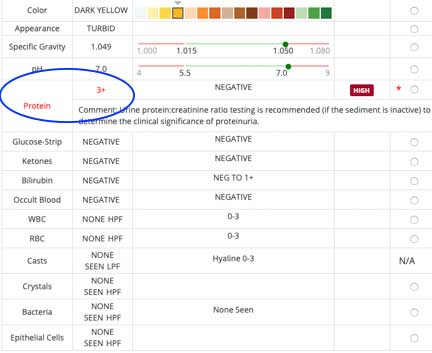
Protein in the urine of an otherwise normal cat on exam and blood panel are an indication of potential kidney disease. The blood pressure needs to be checked on these cats, no matter how well they feel or how good the other diagnostic tests are.
Cause
Feline hypertension is almost always secondary to other problems, namely hyperthyroidism and kidney failure. The majority of cats with these two diseases will eventually develop hypertension. Any cat that has been diagnosed with one or both of these diseases should be monitored for hypertension every 3-6 months.
Kidney Failure
This is the most common cause of hypertension on the cat. Every beat of the heart sends a significant amount of blood to the kidneys. As cats age the kidneys do not function properly, and through complex mechanisms mentioned in the physiology section, the blood pressure will elevate.
Hyperthyroidism
The increased level of thyroid hormone (thyroxine) in the blood stream causes the heart to increase its output of blood, leading to a racing heart and an increase in blood pressure.
Diagnosis
As in people, hypertension is a silent disease. You don’t feel ill, and there are no obvious symptoms until it is too late. Fortunately, we have sophisticated medical equipment that will help us make this diagnosis.
Signalment
Hypertension is found in cats and dogs. There is no breed predilection, but tends to occur more in males and older animals.
History
Older cats that have racing and pounding heart rates, along with blindness, give an indication of hypertension. Hypertension is suspected in cats that have been diagnosed with kidney or heart disease in addition to hyperthyroidism.
Physical Exam
In most cases there are no obvious physical abnormalities. Blood samples that are easily obtained, or pulsate in the syringe when obtained, are an indirect indication of hypertension. The pupils might be dilated, the thyroid gland might be enlarged, the kidneys might feel abnormal, and there could be blood in the urine (hematuria) or nose bleed (epistaxis).
An examination of the retina by a veterinary ophthalmologist will sometimes give an indication of hypertension. There might be areas of hemorrhage or even detachment of the retina. Every blind cat should be seen by an ophthalmologist to check for hypertension, along with other causes of blindness like FeLV, FIP, fungal infections, and Toxoplasmosis.
Any cat that has borderline high BP (150 mm HG to 160 mm HG) consistently should have an eye examine by a veterinary ophthalmologist, especially if it has any underlying problems like kidney disease or feline hyperthyroidism.
Diagnostic Tests
An important tool in the diagnosis of hypertension is a blood pressure (BP) monitor. Cat arteries are very small, and the usual method to detect hypertension in people is not accurate in cats.
We use a machine that measures blood pressure using high definition oscillometry (HDO). Prior to this we used the Doppler, but this new HDO technology is the way to go for animals.
The number that is given is the pressure in the arteries measured in mm of Hg (mercury).
Only the systolic blood pressure reading is accurate in a cat. Systolic is the first and higher number of the two, and is what is occurring when the heart is actively contracting.
Taking a blood pressure reading on a cat is more difficult than in a person. Their arteries are very small, and of course, cats are covered with hair. Also, cats don’t sit still, and are easily stressed, which can lead to a false reading. We will routinely take several readings, discard the lowest and highest, and average the rest. Sometimes we find a cat with consistent readings each time, so not as many readings are needed.
We prefer to check the BP on a cat first thing in the morning before we get busy. Bring its own bedding to lay on. We recommend letting it roam around the exam room for 5-10 minutes prior, and even keep it in its carrier with the top removed during the readings. We want you to be in the room to keep your cat calm, and to watch the machine as it takes its readings.
We take our first pressure reading when everything is calm and all equipment is set up. Notice in the video below how calm the cat is and how quiet the atmosphere for an accurate reading.
In most cats we take 5 readings to look for trends and increase accuracy. The first reading is discarded in our interpretation. Even though the machine gives us an average BP of the 5 readings, and also gives us a diastolic reading, these are not accurate in cats and are not routinely utilized in interpretation.
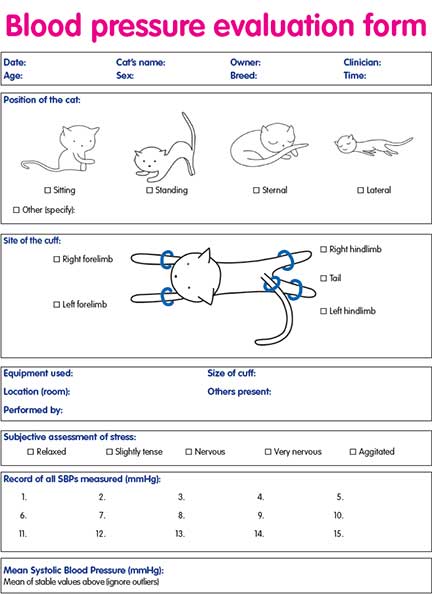
We use this form to record all of the details needed for interpretation now, and also for consistency in future readings
We recheck the BP on a different day for any cat that has hypertension according to the machine. We do not want to start them on medication unless we feel it is needed since the medication will be needed for the lifetime of your pet in many cases (except feline hyperthyroidism possibly). This is no different than in people.
A cat with a systolic pressure of 160 mm of Hg (mercury) or higher is suspected of having hypertension, over 170 mm Hg is considered to be hypertensive. In dogs we consider over 180 mm Hg to be hypertension. Sight hounds, overweight, and older animals tend to have higher numbers. These are not hard and fast numbers, just a guideline for each individual case. In many cases of high readings we repeat the blood pressure readings later to check for consistency in the readings, especially in cats.
If your cat has other problems, like a detached retina or signs of kidney disease, then a BP of less than 160 might be considered high, and it needs to be monitored closely.
Low blood pressure can be of significance in animals also, and the same machine used to detect hight BP can be used to detect a low BP. This low BP might happen when a pet is in shock during an emergency, or has a disease called Addison’s.
Usually low BP is encountered during anesthesia. Our Surgical Monitor unit allows us to monitor the blood pressure during anesthesia and make corrections as needed.
During anesthesia we keep a careful watch on many parameters besides blood pressure.
Treatment
Underlying treatment of the disease that is causing the hypertension is sometimes all that is needed to prevent hypertension. In kidney disease the use of K/D food, with its decreased salt (sodium chloride), phosphorus and protein can be very beneficial.
If your cat has hyperthyroidism we will treat for that, and usually the blood pressure returns to normal
If hypertension still persists after treating the primary problem then we sometimes will use specific medications to lower the blood pressure. This drug is what is called a calcium channel blocker, and it used extensively in those humanoids to control hypertension.
By far the most common and effective one is called amlodipine (Norvasc®). It is usually given at a 1/4 of a tablet once per day (every 24 hours). If the BP is over 200 mm HG we might start at 1/2 tab once per day. Our goal is to get the BP at around 150 mm HG. Lower is better, although we don’t want it to go lower than 110 mm HG.
If there is no improvement in BP over 1-2 weeks the dose is slowly increased, and underlying problems are looked for. Transdermal amlodipine that is absorbed through the skin and is used on cats that are hard to pill is not as consistent as the oral medication in controlling BP.
Other drugs can be used on their own or in combination for the rare time amlodipine does not work. They include:
Heart Drugs
ACE inhibitors like Enalapril, Benazepril, or Lotensin® (prevent conversion of angiotensin to angiotensin II, thus decreasing stroke volume and vascular resistance)
Beta-adrenergic blockers like Propranalol® or atenolol® (decrease the heart rate)
Diuretics
Lasix® or aldactone (decrease the stroke volume)
Vasodilators
Hydralazine (decrease vascular resistance)
Monitoring
All pets with hypertension should have their blood pressure checked every 3 months. In addition, blood panels, thyroid tests, urinalysis, and eye exams should be performed every 3-6 months.