

Introduction
Squamous Cell Carcinoma (SCC) is a serious disease, but if caught early enough, there is much we can do about it. Vigilance on your part is the key to noticing any abnormalities warranting an exam by one of our doctors. It occurs in dogs and cats, although much more often in cats.
What is Feline Squamous Cell Carcinoma?
This is a malignant cancer of the skin cells that can spread to the rest of the body and cause serious disease and death. It can be found in a variety of locations in a cat’s body.
In most cases it is one location, although a multicentric version called Bowen’s disease, that is rare in cats, can occur in multiple locations.
Types of Squamous Cell Carcinoma in Cats
There are two predominant versions of this disease; the skin version and the oral version. In this article we will discuss both.
Skin Squamous Cell Carcinoma
The skin version of SCC is caused by excessive amounts of sunshine, so the disease is prevalent here in California. White-haired cats have more than a 13 times greater risk of getting this disease than do cats of other colors, due to their lack of pigmentation.
The oral version of SCC is particularly aggressive, as opposed to the skin version of SCC. 90% of cats with oral SCC are dead within 12 months of diagnosis. Part of this is due to the delay in diagnosis, since cats hide problems, and it is not easy for owners to look into their cat’s mouth.
To help prevent his serious problem from happening in your cat there are three things you can do:
Have us show you how to do an oral exam on your pet during an office call. Our In Home Exam page has more information on performing this exam.
Come in for a yearly Wellness Exam. For older pets, which should examine them every 6 months.
Have your pet’s teeth cleaned, whether it is without anesthesia, called a Non Anesthetic Dental, or under anesthesia. In each of these we perform a complete oral exam.
Oral Squamous Cell Carcinoma
This is a particularly aggressive form of the disease that has unique biological behavior. It is also known as Feline Oral Squamous Cell Carcinoma (FOSCC). The oral cavity is a common site for SCC, accounting for 10% of all feline tumors.
The oral version of SCC can occur anywhere in the mouth or jaw. Under the tongue, called the sublingual area, is where it is found most often. The bone of the jaw is commonly involved, and can be readily seen on a radiograph.
Many other tumors tend to be found in the lungs when they spread from their original location to the rest of the body. This is not the case for oral SCC. If it spreads it is oftentimes found in the submandibular lymph on the same side of the mouth as the tumor.
These tumors grow rapidly, and are usually well entrenched by the time a diagnosis is made. At this stage the prognosis is poor, so early detection is vital. This as another affirmation of the need for complete physical exams in cats, especially as they age. Older cats need frequent exams to catch this disease and other geriatric diseases before they have progressed too far.
The average age of cat with oral SCC is 12 years, although it has been diagnosed in cats much younger. It can occur in most any breed of cat. One year survival rate is less than 10%. Most cats succumb to FOSCC 2-5 months after diagnosis.
Causes of Oral Squamous Cell Carcinoma
The exact cause is unknown.
Symptoms
Typical symptoms might include halitosis, difficulty eating (dysphagia), blood from mouth or in water bowl, and drooling. Other symptoms can be subtle and non-specific. These include weight loss, hiding, and decreased grooming. Oral SCC can be present without any outward signs.
Is postulated that cats exposed to tobacco smoke have an increased chance of getting oral SCC. This is the same for cats wearing flea collars and those that ate canned food as opposed to dry food, especially canned tuna. It is not sure why cats eating dry food has less SCC, possibly because they might have less tartar leading to better oral hygiene. More work needs to be done in these areas to delineate a cause.
Diagnosis
It is diagnosed by physical exam and biopsy of suspected lesions. The only effected way to examine a cat with suspected squamous cell carcinoma is to anesthetize it and perform a thorough oral exam. Fortunately, this is what occurs when we clean a cat’s teeth when it has dental disease. Our Dental Disease page has much more detail.

This cat has it on its lower jaw (arrow) on the right side. The diagnosis was verified during a biopsy while its teeth were cleaned. SCC can mimic tooth root abscesses, so biopsies are recommended if we suspect it while cleaning your cat’s teeth.

A close up view shows how extensive it is

The radiograph of this cat shows how the cancer has invaded the jaw. There are two areas to note on this view of the lower jaw. The right jaw bone (on the left in the picture) is affected. It has a moth-eaten appearance that can be visualized by comparing it to the left side of the jaw.
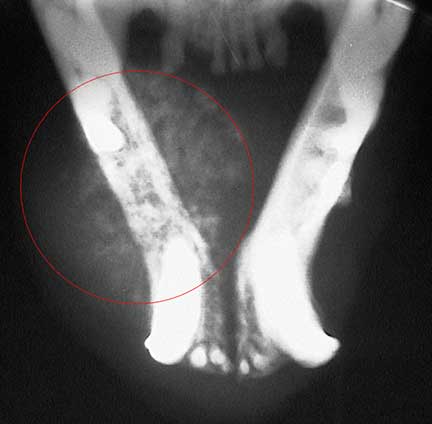
Everything within the red circle is diseased tissue. In addition to the bone lesion, the tissue of the mouth surrounding the bone is also affected. This is visualized on the radiograph as the whitish area surrounding the right jaw bone. This is the tissue that was biopsied to confirm the diagnosis. At this stage of the disease the jaw on the affected side needs to be completely removed.
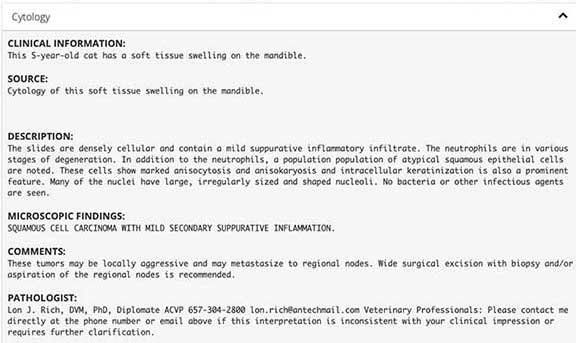
What a SCC cytology report looks like
Treatment
The only treatment at this point is to remove this side of the whole lower jaw. This is called a mandibulectomy. If the problem is in the tongue, chemotherapy can be used to prolong life. Radiation therapy can be used if the problem is in the upper jaw. Neither treatment is rewarding. We recommend a feeding tube in these cats to aid in their nutrition.
This surgery will be undertaken only if there is no evidence that the tumor has spread by taking an x-ray of the chest and biopsying one of the lymph nodes in the neck. It is an extensive surgery, yet most cats do fine postoperatively. If we do not remove the jaw on this side the problem will not be solved.
Complications can occur after surgery for oral SCC, although most people find them manageable. These complications include difficulty in eating. A feeding tube sometimes needs to be placed if the complications are severe enough. Minor complications might include tongue protrusion and difficulty grooming.
You can learn much more about how we anesthetize cats and perform surgery on animals.
Prognosis
The prognosis is guarded to poor, and depends on how long the cancer has been present and where it might have spread to.
Prevention
The best prevention is close observation of your cat’s habits, routine Wellness Exams by one of our veterinarians, and performing your own In-Home-Exam in-between our routine exams. Please study the following links to learn more:
Skin Squamous Cell Carcinoma
In the skin version of SCC, white-haired cats usually get the problem on the ears, head, eyelids and tip of the nose. Cats that are not white usually develop the lesions on unpigmented areas or areas of sparse hair. It occurs mostly in older cats, but the age at which it occurs depends on each individuals’ amount of exposure to sunshine and lack of pigmentation.
Causes of Skin Squamous Cell Carcinoma
Excess exposure to direct sunlight is a major cause, especially in white -haired cats.
Symptoms
Early symptoms of the disease can be subtle, such as a minor irritation or scab on the head, ears, or nose. In more involved cases there is obvious redness, irritation, scabs, and hair loss. These symptoms mimic other diseases, especially skin conditions caused by Ringworm, Sarcoptic mange and allergies, so an accurate diagnosis is imperative.

This tiny ulceration at the tip of this cat’s nose is typical of the subtle lesion that is possible with SCC in cats

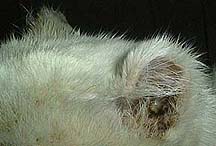
The small red spot on this cat’s ear could also be caused from SCC
Diagnosis
It is important to make a correct diagnosis early in the course of the disease because it can significantly affect the final outcome. Diseases that can mimic the oral SCC include:
Tumors
- Fibrosarcomas
- Lymphomas
- Melanomas
- Adenocarcinomas
- Mast Cell Tumors
Infections
- Cryptococcosis
- Blastomycosis
- Actinomycosis
Dental Lesions
- Periodontal disease
- Endodontic disease
- Benign growths
- Polyps
- Epulis
- Gingival hyperplasia
- Eosinophilic granuloma
The primary method of diagnosis for this disease is a skin or mouth biopsy. Any suspicious lesion should be biopsied since the prognosis is much more favorable the earlier the treatment. If we suspect oral SCC we might peform a biopsy or Fine Needle Aspirate (FNA) of a nearby lymph node. Many cats have lesions that are so suggestive of the disease, or the tumor is so large, that we perform surgery to completely remove the tumor at the same time we are doing a biopsy.
Lymph nodes affected with SCC can be normal in size, as opposed to lymph nodes with other cancers, especially lymphosarcoma, that can become substantially enlarged. On another note, an enlarged lymph node in a cat that has oral SCC can be negative for the tumor in the lymph node, so that lymph node is enlarged for some other reason. The bottom line- a physical exam only checking the external lymph nodes by palpation is not adequate to determine spread of the oral SCC. An FNA or biopsy of the lymph node is needed.
Prior to any biopsy we need a blood panel, urine sample, and Felv/FIV tests. Some cats with bone lesions due to SCC will have a high calcium level (hypercalcemia).
Most SCC’s do not spread throughout the body, but they can recur at the site of the original lesion. Those that do spread will go to lymph nodes and the lungs. Prior to any treatment it is important to take a blood sample, a chest x-ray, and a sample of lymph node tissue for analysis. This helps stage the disease and let us know what the proper treatment regimen should be. All cats with this disease must be tested for FeLV and FIV

This is the radiograph of a pet that has cancer that has spread to its chest. The arrows point to small white areas that are the actual tumor masses that are in the thorax. They lodged here after spreading via the bloodstream from the original tumor located elsewhere in the body.
Treatment
Cats with SCC, especially the oral version, are in pain and can be in poor nutritional state. We determine this by a physical exam with a routine blood panel examination. Before any surgery we institute pain control and supplemental feeding, including a feeding tube if necessary.
The advent of the carbon dioxide laser in our hospital has made both of these surgeries more manageable and less painful for our patients.
Skin Squamous Cell Carcinoma is a malignant cancer that needs immediate and aggressive therapy if we hope to arrest it. The primary treatment method is surgical for the skin and oral versions. It involves removal of the affected area or partial amputation of the ear or ears. Treatment with chemotherapy or radiation are unrewarding.
If the lesion is on the nose or head, a great effort is made to preserve a cosmetic look. Again, this emphasizes the need for an early diagnosis. If the lesion is on the ear then a partial amputation of the ear is performed. It is important to remove a significant amount of the ear because recurrence is common if the amputation is incomplete. The redeeming part of this surgery is the fact that most cats look cute when healing is complete.

Some SCC lesions are very extensive. In a case like Ashley’s, we have to amputate almost the whole external ear due to the extensive nature of the lesion. We prefer to care for these situations long before they become this extensive.

This cat, under general anesthesia and ready for surgery, has been positively diagnosed with SCC on both of its ears, even though the problem only seems minor compared to Ashley. The small amount of redness and the minor scabs are the only apparent lesions in this case.
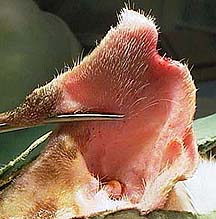
Since it is impossible to determine just how far the tumor has spread, wide margins are cut to minimize the potential for recurrence
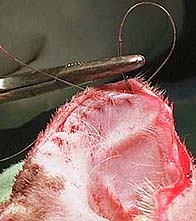
The delicate suturing of the ear takes the most time in this procedure. The cosmetic appearance when healing is complete makes the time invested well worth it. Before your pet wakes up from anesthesia we will give it pain medication to minimize discomfort.
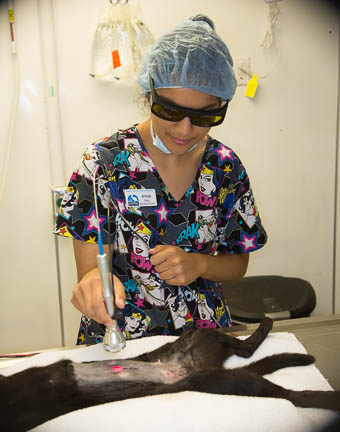
We also use the Companion Laser after surgery to minimize swelling and discomfort. In this picture it is being used after a spay (OVH) surgery.

This is the appearance of the ears immediately after surgery. Within 7-10 days these sutures will be removed.
Four weeks later this is the final appearance. Many people do not even notice that any surgery has been performed. It is important to keep this cat out of the sunshine indefinitely.
We routinely perform this surgery using the carbon dioxide laser. The significant advantages are minimal bleeding during the surgery, negligible post operative pain, and no need to put sutures in for some cases.

The laser is very specific in how it performs surgery, and is specifically calibrated for each procedure.
You can see how it checks its circuits and is calibrated in this video
SSC can occur in other locations, and in other species besides cats. Dogs can also get SCC, although we don’t see it in the mouth and ears as often as we do in cats.

This limping dog has SCC at its toe (arrow). You can see how the bone is being destroyed. Phalanx #2 and #3 are involved.

We amputated the toe all the way up to the metacarpal joint using the laser. The arrow points out where the toe used to be. This radiograph looks different from the one above because it was take immediately after surgery and there was a bandage on the foot. This dog walked out after surgery pain free, partly because we did the surgery by laser, partly because the painful toe is gone.
Prognosis
It is fair to good if caught early enough and there is no indication that is has spread.
Prevention
The same as the oral version, keep a close eye on your cat’s habits, and watch for any signs on its skin or ears or nose.
Additional Treatment Regimens
Radiation therapy using Sr-90 is sometimes used on cutaneous SCC of the nose and ears.
A drug for Mast Cell Tumors (MCT) called Palladia (Toceranib phosphate) has shown some promise in survival time. Further studies are needed to see if this pans out.
NSAID’s (Non Steroidal Anti-inflammatory Drugs) like Metacam (Meloxicam) have been shown to be beneficial in post operative pain and swelling of oral squamous cell carcinoma (FOSCC). These cats eat and feel better, so they are worth it to use if needed.
Care must be taken to make sure the kidneys are not in failure before use of this drug. If chronic kidney disease is present it still might be worth using Meloxicam, since these cats will perish from the FOSCC problem long before the kidney problem in most cases.
A potential treatment for SCC is called Photo Dynamic Therapy. It involves the use of a laser beam to selectively destroy cancerous tissue only. An injection of photosensitive chemical is given to a pet that has SCC. The only cells that absorb this chemical are the cancerous ones. It is only these cells that are destroyed by the laser, the laser beam harmlessly passes through the normal cells that do not absorb the photosensitive chemical. If one of our doctors feels that this therapy is appropriate, they will let you know. It is considered experimental therapy, and is performed locally at the Beckman Laser Institute at the University of California at Irvine, on a referral basis only.
Conclusion
The best method of prevention for skin SCC is to eliminate exposure to sunshine. The use of sun block on the tip of the nose and ears is helpful if your cat does not lick or rub it off. White haired cats should be kept indoors, and should be prevented from sunbathing for long periods of time in the window. Even though windows filter out ultraviolet radiation, they do not filter enough of the radiation in the case of SCC.
Older cats need exams at least every 6 months to aid in the early diagnosis of the other forms of SCC, especially the oral form. Careful observation of your cat’s habits as it gets older is important for FOSCC, along with many other geriatric diseases.
Return to top of page
Return to Feline Diseases page