

Introduction
The Himalayan is a Persian-type cat with a short face, heavy body and long, thick coat. This breed arises from the Persian cat, with Siamese bloodlines introduced (about 60-70 years ago) to get the striking ‘pointed’ coloration.
Like all long-haired cats, they need frequent brushing and regular grooming. They tend to have gentle dispositions and make very good pets.
Common Himalayan Cat Diseases
Hereditary Cataracts
This appears as cloudiness to both of the eyes, and affects the lenses
Brachycephalic Syndrome
As a ‘brachycephalic’ (a short-faced ) breed, Himalayans can have upper respiratory issues and ‘epiphora,’ which is the tear-staining right below the eyes seen in many short-faced breeds (dogs and cats). Their shortened faces predisposes them corneal abrasions and ulcers. They’re also known for ‘Corneal Sequestration,’ a complication of corneal damage, sometimes requiring surgery and usually leading to long-term scarring and impaired vision.
Since they have a more difficult time breathing with this flattened face their ability to breath in hot weather, along with their exercise tolerance, is diminished. Being obese adds to this significantly, so do not overfeed.
Kidney Disease
Himalayans are susceptible to hereditary kidney problem known as Polycystic Kidney Disease (Polycystic Renal Disease). Early symptoms include excess drinking and urinating, so always monitor your cat’s water consumption and urine output. This disease is diagnosed with a blood panel and urinalysis. Ultrasound confirms the diagnosis and gives us the degree of pathology.

These are normal kidney values. A cat with PKD will have much higher numbers than this.
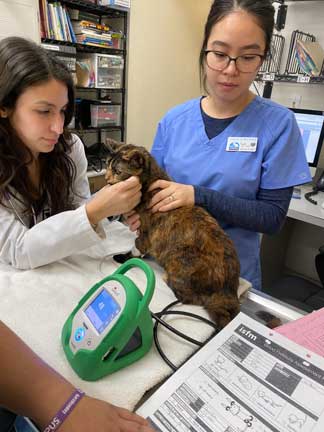
How we take a blood pressure in a cat
Our Kidney Page has detailed information on how we diagnose and treat kidney problems in animals.
Heart disease (Hypertrophic Cardiomyopathy)
This is a serious disease, so a routine yearly exam can help detect this by listening to a murmur or irregular heart beat. This type of heart failure can be catastrophic and even lead to immediate death with no symptoms at all.
A heart murmur is found using a stethoscope by ausculting (listening with a stethoscope) to the heart.
Heart Murmur Sound
A radiograph (X-ray) is also used in the diagnosis of heart disease in cats.
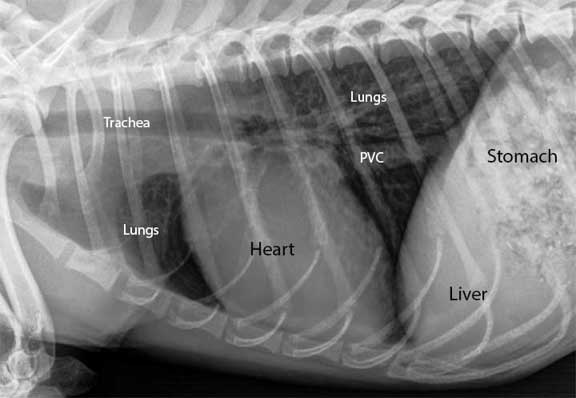
A normal radiograph showing the location of various organs.
EKG or ECG (Electrocardiogram)
This is used to look at the rhythmic rate of the heart as it beats.

A normal EKG
Echocardiogram
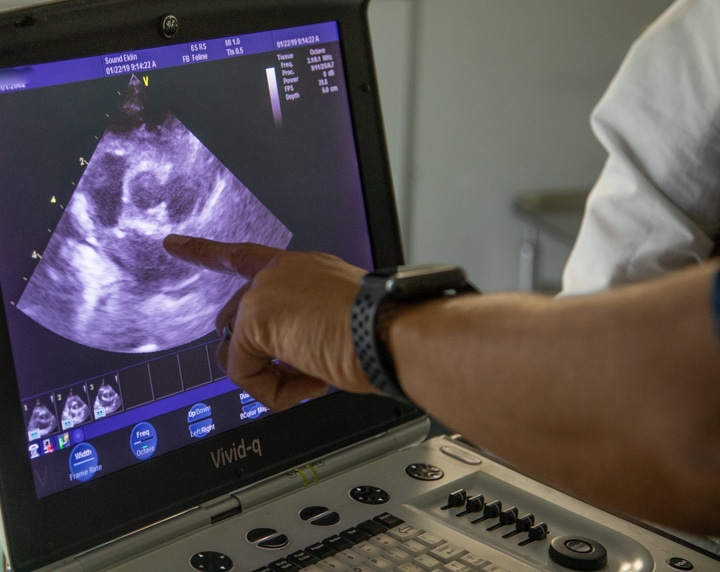
The definitive test for heart disease in animals is an echocardiogram
We have a detailed page on cardiology if you would like to learn much more about heart disease in animals.
Feline Asthma
Himalayans have a higher than usual incidence of, possibly from genetic susceptibility. Watch it breathing while at rest, and have an exam done if there is labored breathing or coughing.

This is what feline asthma looks like on a radiograph
Our Asthma Page tells you all about this problem in cats.
Urinary Tract Disease
They can also get a urinary problem causing bloody urine. This problem can be present without you noticing it, so daily litter pan cleaning and observation is important, and be on the alert for straining to urinate and excess licking of genitalia. It could be a condition known as FLUTD ( Feline Lower Urinary Tract Disease). This can become serious, especially in the male. It could also be a sign of a stone in the bladder.
Learn more about FLUTD from our Urinary Tract Disease Page.
Himilayans are long-lived, and need constant monitoring for problems. One of the best ways to increase its life span is to keep its weight down and get the teeth cleaned every 6 months. We do this by performing a non-anesthetic dental. Please read our Dental Page to learn about this overlooked and important health measure in Himalayan cats.
All of these possible problems emphasize the need for yearly exams and routine diagnostic tests to catch problems early. Many of the diseases of this breed are found in the Diseases section of our web site.